Of all the habits we write about, this one costs the least: when you finish a meal, get up and walk. Not a workout. An easy stroll of two to fifteen minutes, started soon after you put the fork down. That’s it.
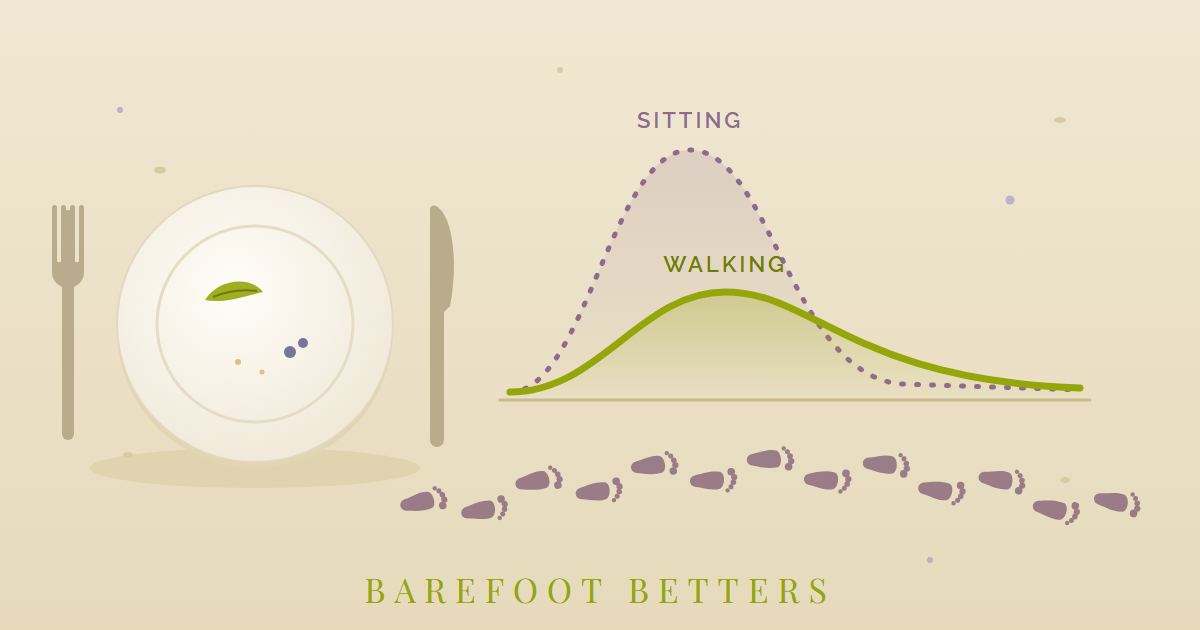
It works because of what your muscles do with sugar. After a meal, glucose pours into your blood. If you sit, it has nowhere quick to go, so it climbs, and your body releases insulin to push it into storage. If you walk, your leg muscles start pulling that glucose in for fuel. Contracting muscle can do that without waiting on insulin. The spike comes in lower, it comes down sooner, and your body needs less insulin to handle the same meal.
What the people we follow say
Several of the voices we lean on across this site reach the same conclusion from different angles.
- Dr. Eric Berg, DC. His site’s article on walking after meals makes the practical case: walk within about 30 minutes of eating, start with 5 to 10 minutes and build up, keep it at a pace where you can still talk, and if you only fit in one walk a day, take it after your biggest meal, which for most people is dinner. It credits the walk with a smaller blood-sugar rise, better insulin sensitivity, easier digestion, and help with blood pressure.
- Ben Azadi (Keto Kamp). His video Blood Sugar Spikes Drop 52% If You Do THIS After Eating is about moving in the window right after a meal. The 52% in the title is the top-end result from the University of Houston “soleus push-up” study (more on that below), a seated calf movement you can do at the table. The point fits this whole post: what you do right after you eat changes the spike, not just what you ate.
- Dr. Pal Manickam, MD, a gastroenterologist, in his short video 2 minute walking method to decrease blood sugar: walking after a meal helps digestion, a 15-minute walk lowers blood sugar, and even a few minutes of walking gets you some of that benefit. You don’t have to do the long version to get started.
- Paul Saladino, MD, in his conversation with Azadi on visceral fat, ranks the post-meal walk as S-tier, the best single thing on his list for visceral fat. It’s also free.
- Mastering Diabetes, in Do THIS After Eating to LOWER Blood Sugar INSTANTLY, gives the simplest version: walk 10 to 15 minutes after meals, and move in the first 15 to 30 minutes. If you can’t walk, do seated heel raises. If you have stairs, climb them for 1 to 3 minutes. They cite the studies behind each one, which we’ve pulled into the next section.
What the studies found
The research here is consistent, and some of it is striking for how little movement it takes.
- Short walks after each meal beat one longer walk at another time. In a New Zealand trial, 41 adults with type 2 diabetes were told either to walk 10 minutes after each main meal or 30 minutes once a day. Same total time. Walking after meals brought post-meal blood sugar down about 12% more overall, and about 22% more after dinner, the meal most people follow by sitting on the couch (Reynolds 2016). In India, 64 adults with type 2 diabetes did 60 days of 15-minute walks after each meal and 60 days of one 45-minute walk before breakfast. Post-meal walking did better on daily glucose and on HbA1c, the three-month average (Pahra 2017).
- After dinner is where it shows most. In older adults at risk for diabetes, three 15-minute walks after meals matched one 45-minute walk for 24-hour blood sugar, and beat it clearly for the three hours after dinner (DiPietro 2013).
- Light walking beats standing, and standing beats sitting. A 2022 meta-analysis in Sports Medicine pooled seven trials that broke up long sitting. Standing helped blood sugar a little. Light walking had more than twice the effect on glucose and lowered insulin too, which standing didn’t (Buffey 2022). Standing up from the table is better than staying put. Walking is better still.
- One to three minutes of stairs counts. Young adults ate a mixed meal, then climbed and descended stairs for 0, 1, 3, or 10 minutes. Even one minute lowered blood sugar and insulin compared with sitting, and three minutes also improved insulin sensitivity (Moore 2024).
- The seated calf raise. In the University of Houston study, people did a specific seated heel raise, the “soleus push-up,” during a glucose test. The post-drink glucose rise was up to 52% smaller, with up to 60% less insulin (Hamilton 2022). Those are the top-end numbers from a small study, and other groups in it came in closer to 40%. A 2025 pilot in people with prediabetes found about a 32% smaller glucose rise (Elek 2025). Either way, it’s a lot from a movement you can do sitting down.
- Digestion moves faster. In a German study, a slow walk after a full meal emptied the stomach noticeably faster than sitting with water. Espresso and after-dinner liqueurs, the traditional “digestifs,” did nothing (Franke 2008). That’s the mechanical side of Dr. Pal’s point about digestion. One honest note: in that study the walk sped things along but didn’t change how full or bloated people felt.
Behind all of it is the same mechanism: working muscle pulls glucose out of your blood through a pathway that doesn’t depend on insulin (Erickson 2017). That’s why a walk works even when insulin isn’t working as well as it should.
How to do it
- Timing. Start within about 15 to 30 minutes of finishing. The blood-sugar rise peaks somewhere around 30 to 90 minutes after you eat, and you want to be moving on the way up, not after it’s already peaked.
- Length. Two minutes helps. Ten to fifteen is the sweet spot in most of the studies. Thirty is fine on a nice evening, but you don’t need it.
- Pace. Easy. You should be able to hold a conversation. This is a stroll, not training.
- Which meal. If you only do one, make it dinner, or whichever meal is your biggest or carb-heaviest. That’s the one most often followed by the longest sit.
- Consistency beats length. A short walk after most meals, every day, does more over time than an occasional long one at the wrong time. In the studies above, the post-meal walkers came out ahead on the same total minutes of walking.
- Make it a family thing. A walk around the block after dinner is a good time to talk with your spouse or your kids with no screens in the way. Bring the dog. Habits stick better when other people are counting on them.
When you can’t get outside
Rain, a desk job, a kid asleep on your lap. You still have options:
- Soleus push-ups. Sit with your feet flat and your knees bent at about 90 degrees. Raise your heels as high as they’ll go while the balls of your feet stay on the floor, then let them drop. Keep it smooth and steady, like a slow bounce, for as long as you can. You can do this under the table at a restaurant and nobody will notice.
- Stairs. One to three minutes of up and down at a comfortable pace.
- Chores. Clearing the table, washing dishes, sweeping, folding laundry. Anything that keeps you on your feet and moving beats the couch.
- Stand up. If that’s all you can do, standing still beats sitting.
After workouts, too
A walk isn’t only for dinner. After a workout and a recovery drink, ten easy minutes on your feet helps your muscles take up the carbohydrate you just drank instead of letting it sit in your blood. That’s why our post-workout recovery drink ends with a short walk, and why it’s part of the evening routine after dinner.
Sources
- Reynolds AN, Mann JI, Williams S, Venn BJ. Advice to walk after meals is more effective for lowering postprandial glycaemia in type 2 diabetes mellitus than advice that does not specify timing: a randomised crossover study. Diabetologia. 2016;59(12):2572–2578.
- Pahra D, et al. Impact of post-meal and one-time daily exercise in patient with type 2 diabetes mellitus: a randomized crossover study. Diabetology & Metabolic Syndrome. 2017;9:64.
- DiPietro L, et al. Three 15-min bouts of moderate postmeal walking significantly improves 24-h glycemic control in older people at risk for impaired glucose tolerance. Diabetes Care. 2013;36(10):3262–3268.
- Buffey AJ, et al. The acute effects of interrupting prolonged sitting time in adults with standing and light-intensity walking on biomarkers of cardiometabolic health in adults: a systematic review and meta-analysis. Sports Medicine. 2022;52(8):1765–1787.
- Moore JM, et al. One minute of stair climbing and descending reduces postprandial insulin and glucose with 3-min improving insulin resistance following a mixed meal in young adults. Journal of Exercise Science & Fitness. 2024;22(3):266–270.
- Hamilton MT, Hamilton DG, Zderic TW. A potent physiological method to magnify and sustain soleus oxidative metabolism improves glucose and lipid regulation. iScience. 2022;25(9):104869.
- Elek D, et al. The efficacy of soleus push-up in individuals with prediabetes: a pilot study. Sports. 2025;13(3):81.
- Franke A, et al. Postprandial walking but not consumption of alcoholic digestifs or espresso accelerates gastric emptying in healthy volunteers. Journal of Gastrointestinal and Liver Diseases. 2008;17(1):27–31.
- Erickson ML, Jenkins NT, McCully KK. Exercise after you eat: hitting the postprandial glucose target. Frontiers in Endocrinology. 2017;8:228.
- Dr. Berg’s site: Walking After Meals: Why Post-Meal Walks Matter.
- Ben Azadi, YouTube: Blood Sugar Spikes Drop 52% If You Do THIS After Eating.
- Dr. Pal Manickam, YouTube: 2 minute walking method to decrease blood sugar.
- Paul Saladino with Ben Azadi, Keto Kamp: The 5 BEST Ways to Lose Visceral Fat in 30 Days.
- Mastering Diabetes, YouTube: Do THIS After Eating to LOWER Blood Sugar INSTANTLY.
Simplify, create, and live with God in your heart.