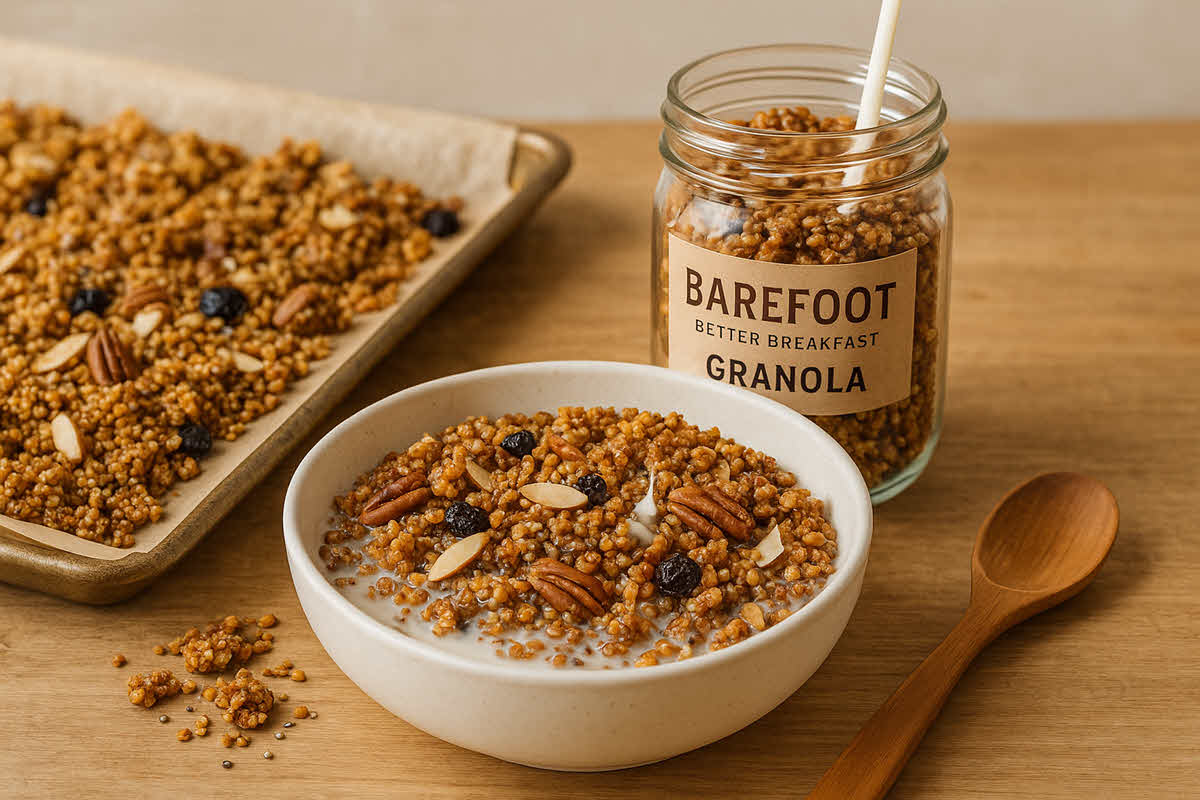

Our Barefoot Better Breakfast Granola has been a favorite for a while now — pressure-cooked, low-sugar, easy on the gut. This is its ancient-grain cousin, built from the ground up for the Intestinal body type: the sensitive “funnel” of Carolyn Mein’s 25 Body Type System, whose whole job is taking food in and discerning what to keep. If that’s your type — or you just want a deeply nourishing, whole-food breakfast — this one was made for you.
The changes here aren’t cosmetic. Amaranth and cooled basmati rice replace the quinoa; date sugar and sorghum syrup replace the maple syrup and monk fruit; and real grass-fed butter carries the fat in place of coconut oil. Each of those swaps was chosen to land on the Intestinal type’s “Frequently” list — the foods this body handles best.
Why amaranth and basmati rice
Here’s the part that surprised us when we checked Mein’s food lists for this type. Most grains slide down the list when an Intestinal body is stressed or run-down. Two don’t: amaranth and basmati rice are the only grains that stay in the top “Ultra-Support / Frequently” tier on both the Healthy and the Sensitive list. When the type is depleted, Mein’s guidance narrows the grains down to essentially basmati rice — and amaranth rides right alongside it.
So building a granola on those two isn’t a stretch to fit a theme. It’s choosing the exact two grains this body keeps digesting well on its worst days. Amaranth brings a genuinely good protein plus iron, zinc, calcium, and magnesium; basmati brings a gentle, familiar base — and cooling the cooked rice builds resistant starch, a prebiotic fiber that feeds your gut bacteria.
Why sorghum, date sugar, and butter
The original granola leaned on maple syrup and monk fruit. Good choices in general — but for the Intestinal type specifically, maple syrup is a “Rarely” food on both lists. Sorghum syrup and date sugar are both “Frequently” sweeteners for this type, on both lists. Swapping to them doesn’t just change the flavor; it moves the recipe up a tier for the body eating it.
And the flavor payoff is real. Date sugar gives you whole-food sweetness with the fruit’s fiber still attached. Sorghum syrup acts as the binder — its deep, molasses-like notes caramelize in the oven into something maple can’t match. Butter does what coconut oil couldn’t: it browns, and it carries flavor. It’s a “Frequently” dairy on a healthy day and one of Mein’s named recommended fats (coconut oil sits at “Moderately” on both lists), so leaning on butter alone keeps the fat in the type’s top tier when you’re strong. This is the distinctive farmhouse profile — market it as ancient-grain granola, not “grain-free” or “quinoa” granola.
Where each ingredient lands on the Intestinal food lists
Here’s the whole recipe scored against Carolyn Mein’s food lists for the Intestinal type:
Built on the type’s anchor foods — 6 that stay top-tier even under stress (12 top-tier in all) — with no “Rarely” foods.
- Amaranth Frequently anchor
- White basmati rice Frequently anchor
- Date sugar Frequently anchor
- Sorghum Frequently anchor
- Walnuts (black, English) Frequently anchor
- Dried pineapples Frequently anchor
- Butter Frequently
- Raisins Frequently
- Dates Frequently
- Cashews (dry roasted / unsalted) Frequently
- Pecans Frequently
- Blueberries Frequently
- Macadamias (raw, roasted) Moderately holds under stress
- Sea salt Moderately holds under stress
Scored against Carolyn Mein’s Intestinal Profile. See the full Healthy vs. Sensitive crosswalk.
The six at the top hold “Frequently” on both lists — the foods this type keeps digesting well even when depleted, and the backbone of the recipe. Butter, raisins, dates, and dry-roasted cashews stay top-tier on a healthy day and only ease back to “Moderately” under stress. Pecans and dried blueberries drop further when you’re run-down; macadamias and sea salt sit at “Moderately” on both lists.
Not on Mein’s 1997 lists (modern additions, or seasoning-level amounts): flax seeds, chia seeds, inulin powder, Ceylon cinnamon, turmeric, ginger, cardamom, vanilla extract, and almond extract. The flax and chia are the fiber and omega-3 boosters called out in the notes; the spices and extracts are used in small enough amounts that they don’t change the recipe’s tier.
Prep the amaranth so your body actually gets the minerals
Amaranth is nutrient-dense, but like most seeds it carries antinutrients — phytic acid, tannins, saponins, a little lectin — that can bind minerals or slow digestion. The old kitchen traditions defeated them, and we lean on those here:
- Soak first (a few hours; stir 1 tablespoon of arrowroot powder into the water). Soaking activates the grain’s own phytase enzyme to break down phytic acid and free up the iron and zinc, while the soak water carries off tannins and saponins. The arrowroot is a gentle starch that softens the soak and helps the grains bind and crisp. Skip the baking soda — it pushes the wrong direction and costs you some B1.
- Cook it through. Lectins are heat-sensitive proteins; a normal simmer denatures most of them, and a pressure cook is the most thorough kitchen method of all. (Dr. Gundry’s worry about amaranth lectins is a minority view — cooked amaranth has been eaten safely for millennia — but if you like a belt-and-suspenders prep, soak then pressure-cook and you’ve cleared it.)
- Optional digestive herb. If you’re sensitive to gas, a pinch of ajwain or a small bloomed pinch of asafoetida (hing) in the pot is the traditional carminative touch. If you’re keeping this gluten-free, check the hing label — many brands are cut with wheat flour.
New to cooking amaranth? This short walkthrough covers the basic stovetop method — the grain-to-water ratio and the porridge-tender finish you’re after before it goes on the sheet pan:
And if it helps to see amaranth cooked simply as a breakfast in its own right, Bubble Green’s amaranth porridge is a nice, uncomplicated look at the same grain:
An honest word on the framework
The 25 Body Type System is Carolyn Mein’s model, not mainstream nutrition — we offer it as a lens some of you find genuinely useful, and we’ve matched this recipe to it carefully rather than hand-waving. What isn’t in question is the food science underneath: soaking, cooking, and pairing grains the traditional way really does make their minerals more available. Eat this when you’re feeling strong, rotate it with your other breakfasts as Mein suggests, and let your own body have the final say.
Simplify, create, and live with God in your heart.
Ancient Grain Granola
Ancient Grain Granola (Amaranth, Basmati, Sorghum & Butter)
A whole-food, Intestinal-type breakfast granola of amaranth, cooled basmati rice, pecans, walnuts, and seeds—sweetened with date sugar and sorghum syrup and baked into deep-golden, buttery clusters.
Ingredients
Equipment
- Pressure cooker or saucepan
- Rimmed baking sheet with parchment or a silicone mat
- Large mixing bowl
Method
- Rinse and soak. Rinse the dry amaranth and dry basmati well. Soak them (separately or together) in fresh water with 1 tbsp arrowroot powder stirred in, then drain and rinse. The soak hydrates the grain so heat penetrates evenly, activates the grain’s own phytase to free up its minerals, and leaches out water-soluble antinutrients.Tip: Arrowroot is a gentle starch that softens the soak and helps the grains bind and crisp later. Skip baking soda here — it works against the phytase that unlocks minerals, costs you some B1, and can turn amaranth slimy.
- Cook the amaranth. Simmer the drained amaranth in about 1¾ cups fresh water, covered, for , until the water is absorbed and it’s porridge-tender — or pressure-cook it. You want about 2 cups cooked.Tip: If you pressure-cook amaranth, don’t fill the pot past one-third and add a teaspoon of oil — the tiny grains foam. Moist high-heat cooking is what denatures lectins, so a normal cook already handles them.
- Cook the basmati. Cook the drained basmati in fresh water by your usual method for about 2 cups cooked. Pressure-cooking is the most thorough way to knock down any lingering lectins; cooling the cooked rice afterward builds resistant starch that feeds your gut.
- Dry for crunch. Spread both grains on sheet pans and air-dry , patting with a towel if needed. The drier the grains, the crispier the granola.
- Combine everything dry. In a large bowl, stir together the amaranth, basmati, amaranth flour, pecans, walnuts, macadamia nuts, cashews, flax, chia, date sugar, inulin, cinnamon, turmeric, ginger, cardamom, and salt until evenly mixed.
- Whisk the wet. In a small bowl, whisk the melted butter, sorghum syrup, vanilla, and almond extract until smooth. Pour over the dry ingredients and mix until everything is evenly coated.
- Preheat the oven to 325°F (165°C) and line a rimmed baking sheet with parchment paper or a silicone mat.
- Spread and press. Spread the mixture evenly on the sheet and press lightly with a spatula for larger clusters.
- Bake , stirring every , until deep golden. The sorghum syrup and date sugar caramelize into a richer, molasses-like flavor than maple syrup ever gives.
- Cool completely (about ) so the clusters set, then stir in the raisins and dried pineapple (or dried blueberries or chopped dates) to keep them chewy.
- Store airtight in the fridge up to 1 month — flax, chia, and inulin all keep best refrigerated.
Notes
- Built on the type’s most resilient grains. Amaranth and basmati rice are the only two grains that stay in the ‘Ultra-Support / Frequently’ tier on both Carolyn Mein’s Healthy and Sensitive food lists for the Intestinal type — the ones your body keeps digesting well even when it’s stressed.
- The swaps move it up a tier. Sorghum syrup and date sugar are ‘Frequently’ on both lists; maple syrup is ‘Rarely’ on both. Butter is ‘Frequently’ on a healthy day (eases to ‘Moderately’ under stress), while coconut oil sits at ‘Moderately’ on both — so carrying the fat in butter still lifts the fat tier on a good day.
- The nuts pull their weight now. Pecans and walnuts are both ‘Frequently’ nuts for this type, and dry-roasted cashews are too — so most of the crunch here is top-tier. Macadamias are ‘Moderately,’ the one to pull back on if you’re strictly optimizing. Flax and chia are modern fiber/omega-3 additions (they predate Mein’s 1997 lists) — sesame, sunflower, and pumpkin are the type’s ‘Frequently’ seeds if you’d rather swap some in and rotate.
- This is a feeling-strong food. It fits the type’s breakfast rule of grain served with fruit or sweetener. In an active weight-loss phase, Mein pulls nuts, seeds, and dried fruit back for this type — so treat it as an occasional breakfast then, not a daily staple.
- Serve smart. A little vitamin C (berries, a splash of citrus) lifts iron absorption from the amaranth and seeds; keep strong coffee or black tea away from the bowl, since their tannins block it. Lovely with whole-milk yogurt, kefir, or almond milk.
More from the Barefoot Betters kitchen:
- Barefoot Better Breakfast Granola — the original, quinoa-based version
- The Intestinal Body Type: A Daily Joy Blend for the Sensitive Soul — meet the type this recipe is built for
- The Most Digestible Pinto Beans — the same soak-and-pressure-cook approach, for beans
- Cardamom & Lemon Basmati Rice in Chicken Broth — more with the type’s most resilient grain